
National Trust Database - Search Results |
Back to search page » | |
| Displaying 1- 10 of 149 records found |
| Image | Name | Detail | File number | Level |
|---|---|---|---|---|
|
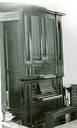
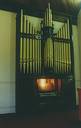
Pipe Organ - St Albans Anglican Church
Melrose Street, NORTH MELBOURNE VIC 3051 - Property No B4706 |
This organ is an example of English organ-building circa 1850-1860. Its early history is unknown but thought to be of English origin. Apart from additions made in 1931 by C W Andrewartha it remains in substantially original form. The pipework, being made up of secondhand odd lots, is older than the organ. Owing to the poor condition of the organ it is very difficult to assess if its sound is original. The attractive organ case is marred by deterioration and the finish is ... more |
B4706 |
Local |
|
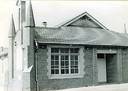
Former All Saints Anglican Church
1 Olive Street,, MALVERN EAST VIC 3145 - Property No B2067 |
B2067 |
File only | |
|
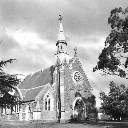
Cameron Street, MALMSBURY VIC 3446 - Property No B1287 |
One of the most charming rural churches of its date in Victoria, designed by Purchas and Swyer in the Decorated Gothic style, and opened in 1866. The western facade embraces an octagonal turret, a deeply recessed doorway, and a rise window with star tracery, and the north aisle incorporates plate traceried windows beneath transverse gables. |
B1287 |
Local |
|
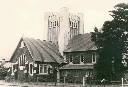
Cnr South Terrace & Gold Street, CLIFTON HILL VIC 3068 - Property No B3402 |
Built 1916. Demolished; December 1975. |
B3402 |
Demolished |
|
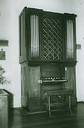
Dodd Organ - St Paul's Anglican Church
Station Street,, FAIRFIELD VIC 3078 - Property No B6134 |
A two-manual organ of 11 stops built in 1922 by the noted Adelaide organbuilder J E Dodd for St Barnabas' Anglican Church, Montague Street, Montague, South Melbourne, and moved to its present location in 1968. This was one of the last mechanical action instruments to be built in Australia before the revival of the craft in the 1960's. Classified: 01/10/1990 |
B6134 |
Regional |
|
Smith Organ & Joscelyne Organ (St James the Great Anglican Church)
435 Inkerman Street,, ST KILDA EAST VIC 3183 - Property No B4862 |
Smith Organ Statement of Significance: This organ is thought to be among the oldest in use in a Melbourne church. It was built about 1850 by the old-established firm of John Smith, Bristol, as a chamber organ for domestic use. Its attractive mahogany case is of Georgian design with Gothick overtones and the side "towers" are supported by finely carved corbels. The early history of the instrument is unknown; it was installed in its present location in 1962 and came from St Matthew's ... more |
B4862 |
State |
|
Graveyard - Holy Trinity Anglican Church
Gisborne Road, BACCHUS MARSH VIC 3340 - Property No B2726 |
B2726 |
File only | ||
|
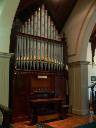
Anderson Organ - St.John's Anglican Church
23 King Street,, FLINDERS VIC 3929 - Property No B6112 |
A single-manual organ of eigth stops, believed to be an early work of the Melbourne organbuilder William Anderson, which has been subject to many moves. Its earliest known location was the Presbyterian Church, Williamstown from where it was removed about 1882 to "Dhurringile", Murchison, the property of James Winter. The organ was moved to its present location in 1939 from the Baptist Church, Kew. It is a substantial example of a single manual organ, with an eight-foot facade. ... more |
B6112 |
Local |
|
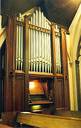
George Fincham Organ- St Bartholomew's Anglican Church
290 Burnley Street,, BURNLEY VIC 3121 - Property No B6216 |
The pipe organ built in 1887 by George Fincham, of Richmond, for St Michael's Catholic Church, Wagga Wagga, NSW was the first pipe organ in the town and one of very few (possibly three) in the wider southern NSW region. It was moved in 1893 to the Chapel of St Peter, within the Church of England Grammar School, South Yarra; this was the first school chapel in Victoria and the organ was played from 1906 by Arthur E.H. Nickson, important Melbourne organist and teacher. The organ was ... more |
B6216 |
Local |
|
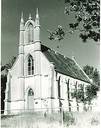
Davy Road(off), TARADALE VIC 3447 - Property No B1169 |
An outstanding example of the picturesque but archaeologically uninformed Regency Gothic style, this stuccoed church built in 1858/9 is dominated by a sham belfry incorporating a large traceried mock window. Classified: 11/12/1958 Revised classified: State: 23/07/1987 |
B1169 |
State |
| 1 2 3 ... 15 | next |
